
Hurry—our Last Minute Stocking Stuffer Sale is your final chance to get 30% off and free shipping on orders over $35! Order by 12/14 to ensure delivery just in time for Christmas Eve. Don’t miss out on these festive favorites!

Search for a Bahama Mama recipe and you’ll find two completely different drinks—one bright pink and juice-forward, one darker with coffee liqueur and a rum-forward structure that barely resembles the first. Both go by the same name. Neither has official backing. This is not a recipe problem—it’s a categorization problem, and understanding it is the difference between building a great Bahama Mama and assembling a sweet mess.
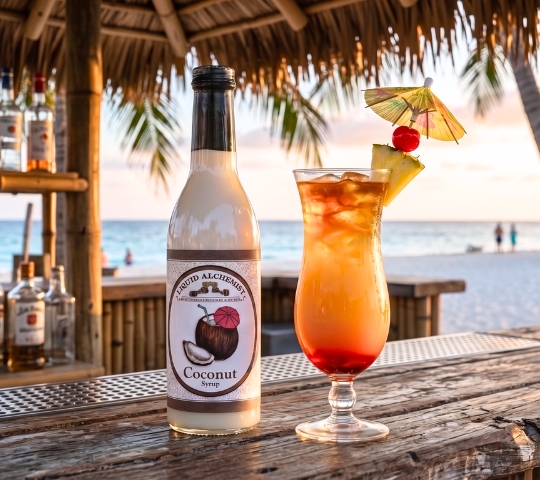
Liquid Alchemist Coconut provides the drink’s defining tropical base with the depth that coconut-flavored rum alone can’t deliver—natural richness without the syrupy sweetness that pushes most resort versions into sugar overload. Below is the full history, both recipe versions explained, and the system for building your own.
The bartender most closely associated with the Bahama Mama is Oswald “Slade” Greenslade, who worked at the Pink Elephant nightclub in Nassau. As documented by Difford’s Guide, Greenslade claims to have created the drink in 1963 for three tourists who wanted something fruity they’d never had before, naming it after a calypso singer who walked into the bar.
The problem, as Vintage American Cocktails notes, is that Greenslade didn’t start bartending until 1961—and the Bahama Mama was already appearing on menus in the 1950s. Food & Wine documents that Nassau’s British Colonial Hotel had the drink on their menu by 1956. Most drink historians conclude that Greenslade likely created his own standardized version of a drink that already existed, not the drink itself.
Travel Distilled traces the “Bahama Mama” name back to a 1932 Big Band song, and to calypso performer Dottie Lee Anderson, who performed under the stage name “Bahama Mama” and appeared on US Billboard charts from 1951 to 1957. Whether the drink was named after the song, the performer, or simply the island it came from, the name predates every origin claim by decades.
This is the fact that most recipe pages skip: there is no single canonical Bahama Mama. There are two structurally distinct versions that share a name and a general Caribbean identity, and most of the recipe confusion online comes from mixing them up.
As analyzed by TT London, the split breaks down clearly: the coffee liqueur version produces a darker, more complex drink with roasted bitterness balancing the tropical fruit; the grenadine version produces a bright, pink-red drink that prioritizes visual impact and fruit-forward sweetness. Both are legitimate—they simply serve different drinkers and different occasions.
This is the version Food & Wine argues is closer to the mid-century original. Coffee’s natural bitterness performs the same structural function as Angostura bitters in other tiki drinks—it prevents the tropical sweetness from dominating and gives the rum somewhere to land.
Shake all ingredients with ice and strain into a tall glass over fresh ice. Garnish with a pineapple wedge and cherry.
This is Greenslade’s version and the most common resort build. The grenadine sinks to create a layered sunset effect and contributes pomegranate tartness rather than coffee bitterness. Liquid Alchemist Grenadine is built on real pomegranate and cane sugar rather than corn syrup, which means the tartness does structural work—cutting the juice sweetness rather than adding to it.
Build over ice in a tall glass—add grenadine last to create the sunset layer. Garnish with orange slice, pineapple, and cherry.
The oldest confirmed version of Greenslade’s build, documented by Got Rum Magazine, actually included a float of Dubonnet—a French fortified wine with herbal and quinine bitterness. This gave the original drink a complexity that neither the coffee liqueur version nor the modern grenadine version fully captures.
Dubonnet was eventually dropped when it became difficult to source in the Bahamas, and coconut rum replaced it. The substitution shifted the drink from a structured, bittersweet tropical build toward the fruit-forward profile that’s now standard. Understanding this evolution explains why older recipes taste more layered and why modern versions often feel one-dimensional despite using more ingredients.
The Bahama Mama’s lack of a canonical recipe is actually an advantage once you understand its core architecture: rum base, coconut layer, citrus acid, and a sweetener-or-bitter component that determines the drink’s character.
Liquid Alchemist Coconut at ¼ oz allows you to use any rum as your base without needing a dedicated coconut rum—which matters because coconut rum is typically low-proof and sweet, reducing the drink’s structure. With coconut syrup, you can choose a full-proof aged rum for a more spirit-forward result while still hitting the tropical coconut note the drink requires.
Liquid Alchemist Passion Fruit at ¼ oz adds a tart tropical acid note that replaces some of the orange juice volume—reducing the sugar load while increasing flavor complexity. Liquid Alchemist Mango at ¼ oz alongside pineapple juice extends the tropical fruit layer without adding sweetness, since mango syrup’s natural tartness is closer to passion fruit than to simple syrup. For more tropical builds and techniques, grab our free cocktail guide for recipes that go beyond the resort standard.
The Bahama Mama is structurally ideal for pitchers—it holds well, scales cleanly, and the sunset layer can be recreated at serving time by adding grenadine to individual glasses before pouring.
Combine everything except the grenadine and refrigerate up to 24 hours. Pour over ice per glass, add grenadine last. The batch stays fresh; the presentation stays dramatic.
The Bahama Mama’s greatest strength is also its identity: no one owns it, no one standardized it, and every island that made it called it theirs. That’s not a flaw in the recipe—it’s a feature of a drink that was designed to work with whatever was available on a Caribbean bar shelf in the 1950s.
Liquid Alchemist Coconut is the ingredient that lets you take the base in any direction without being locked into coconut rum’s proof and sweetness limitations. The Tiki Cocktail Syrup Gift Set adds Falernum, Almond Orgeat, and Passion Fruit to complete every tiki-adjacent variation the formula can hold. Use code TRYUS for 25% off plus free shipping on your first order.
Unlike IBA-standardized cocktails, the Bahama Mama has no official recipe and no single creator whose version took precedence. It emerged from Caribbean bar culture in the 1950s and spread through resort hotels and tourist bars that each adapted it to their available ingredients. The result is a category of tropical rum drinks that share a name and general flavor direction without any single canonical formula.
The coffee liqueur version is darker, drier, and more structurally complex—the roasted bitterness of the coffee balances the pineapple sweetness and anchors the rum. The grenadine version is brighter, sweeter, and visually dramatic, with the pomegranate syrup creating a layered sunset effect. The coffee version is closer to mid-century Caribbean originals; the grenadine version reflects the resort-bar evolution of the 1970s and beyond.
Coconut syrup is structurally preferable to coconut rum for a well-built Bahama Mama. Coconut rum is typically low-proof (usually 21% ABV) and sweet, which reduces the drink’s spirit backbone and adds sugar volume. Using a full-proof aged rum with a small measure of coconut syrup gives you more control over sweetness and allows the rum’s character to come through rather than being masked by coconut flavor.
Dubonnet’s quinine bitterness and herbal complexity gave the original a rounder, more structured profile than modern versions. The closest modern approximation is the coffee liqueur version, which performs a similar bitter-balancing function. Adding a dash of Angostura bitters to either version also moves the flavor closer to what the Dubonnet float would have contributed—bitterness that prevents the tropical sweetness from dominating.
Pour all ingredients except the grenadine into the glass over ice, then slowly add grenadine over the back of a bar spoon against the inside edge of the glass. The grenadine, being denser than the juice mixture, sinks to the bottom and creates a gradient from deep red at the base to golden-orange at the top. The effect works best in a tall clear glass and dissipates as the drink is stirred, so serve immediately.
It occupies the boundary between tiki and resort cocktail. It uses tiki elements—multiple rums, tropical juices, layered sweeteners—but lacks the structural rigor of classic tiki builds like Three Dots and a Dash or the Mai Tai. Got Rum Magazine describes it as “surprisingly complex for a tropical drink,” particularly in its original Dubonnet-included form. Most tiki historians classify it as a Caribbean tropical cocktail with tiki influences rather than a true tiki drink.
A zero-proof version replaces the rum base with cold-brewed coconut water for body, a small amount of tamarind for the funky rum-adjacent depth, and sparkling water for lift. Keep the pineapple juice, orange juice, and grenadine or passion fruit syrup in the same ratios. The result lacks the rum’s structural weight but preserves the drink’s tropical fruit-coconut-citrus balance, making it a viable mocktail for non-drinkers at the same event.

Hurry—our Last Minute Stocking Stuffer Sale is your final chance to get 30% off and free shipping on orders over $35! Order by 12/14 to ensure delivery just in time for Christmas Eve. Don’t miss out on these festive favorites!
Get notified about new articles
Margarita Day Special
25% Off Prickly Pear, Blood Orange, Passion Fruit, Peach, Tamarindo, Strawberry, & Mango February 22 only
Kick off the new year with our Dry January Sale! From 12/27-1/15, enjoy 25% off on all featured flavors in our Dry & Damp Cocktail Guide, perfect for crafting delicious non-alcoholic and low-ABV drinks to help you start the year refreshed and on trend!
CODE: SMBIZ
CODE: BLKFRI